Learn about current park closures and updates.

Learn about current park closures and updates.

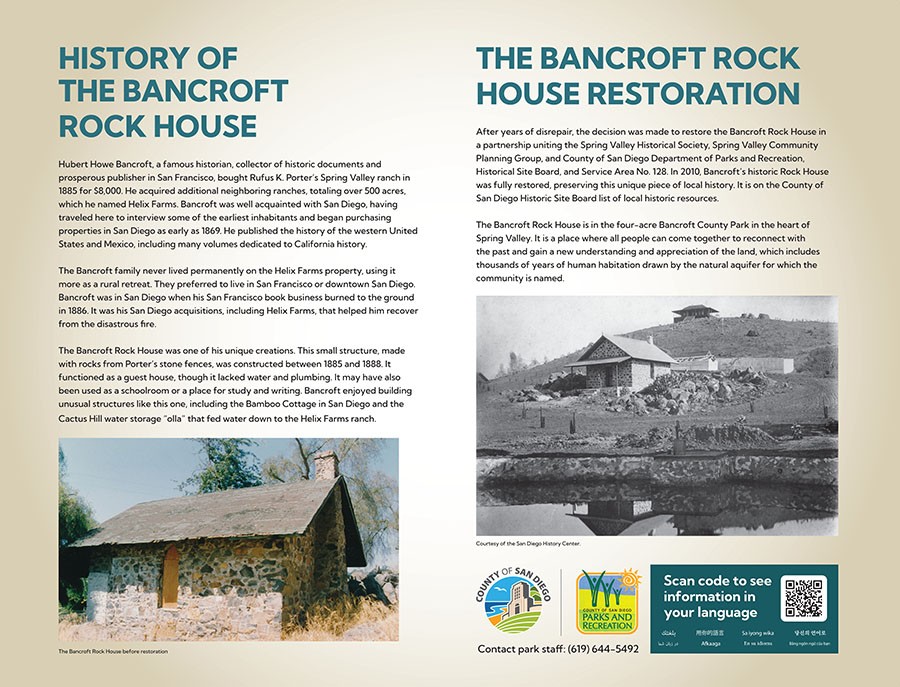
Hubert Howe Bancroft, a famous historian, collector of historic documents and prosperous publisher in San Francisco, bought Rufus K. Porter’s Spring Valley ranch in 1885 for $8,000. He acquired additional neighboring ranches, totaling over 500 acres, which he named Helix Farms. Bancroft was well acquainted with San Diego, having traveled here to interview some of the earliest inhabitants and began purchasing properties in San Diego as early as 1869. He published the history of the western United States and Mexico, including many volumes dedicated to California history.
The Bancroft family never lived permanently on the Helix Farms property, using it more as a rural retreat. They preferred to live in San Francisco or downtown San Diego. Bancroft was in San Diego when his San Francisco book business burned to the ground in 1886. It was his San Diego acquisitions, including Helix Farms, that helped him recover from the disastrous fire.
The Bancroft Rock House was one of his unique creations. This small structure, made with rocks from Porter’s stone fences, was constructed between 1885 and 1888. It functioned as a guest house, though it lacked water and plumbing. It may have also been used as a schoolroom or a place for study and writing. Bancroft enjoyed building unusual structures like this one, including the Bamboo Cottage in San Diego and the Cactus Hill water storage “olla” that fed water down to the Helix Farms ranch.
After years of disrepair, the decision was made to restore the Bancroft Rock House in a partnership uniting the Spring Valley Historical Society, Spring Valley Community Planning Group, and County of San Diego Department of Parks and Recreation, Historical Site Board, and Service Area No. 128. In 2010, Bancroft’s historic Rock House was fully restored, preserving this unique piece of local history. It is on the County of San Diego Historic Site Board list of local historic resources.
The Bancroft Rock House is in the four-acre Bancroft County Park in the heart of Spring Valley. It is a place where all people can come together to reconnect with the past and gain a new understanding and appreciation of the land, which includes thousands of years of human habitation drawn by the natural aquifer for which the community is named.
Welcome to Bancroft County Park, where people have lived for thousands of years. The earliest, the Kumeyaay Indians, for centuries maintained a village here called Meti or Neti depending on translations. During Spanish and Mexican times, cattle and sheep from the Mission San Diego de Alcala may have grazed on the land. Between 1863 and 1918, three different American ranchers owned the property.
People of many backgrounds worked to improve the area. All have left their mark on the land.
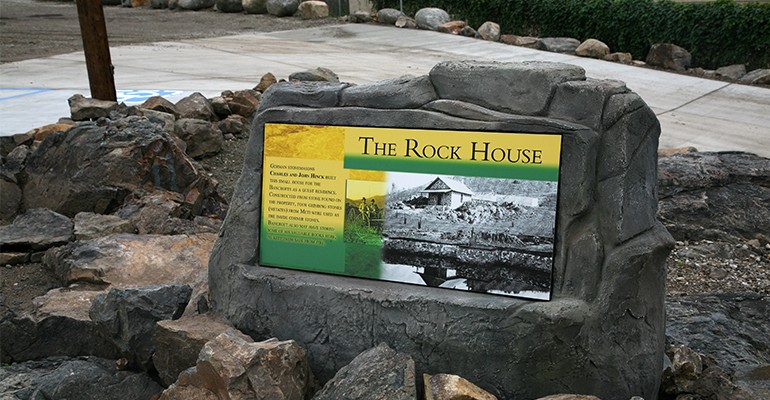
Local German Stonemasons, Charles and John Hinck built this small rock house for the Bancroft family. Constructed from stone found on the Ensworth corral, this structure’s interior featured four metates (grinding stones) from the village of Meti (Neti).
Augustus S. Ensworth | 1863-1865 Ownership
The first American to own this land was Augustus S. Ensworth, a one-term California State Assemblyman and local lawyer. Understanding the value of the spring on the property, he made a claim for the land in 1863. He called his holding San Jorge Ranch and brought sheep here to graze.
To fulfill the requirement to improve the property, Ensworth had an 18x32 foot adobe and wood ranch house built near the spring. He used timber from a sunken coal ship, called the Clarissa Andrews, which had gone aground in San Diego Bay.
A year after starting his sheep ranch, Ensworth suffered a serious injury to his leg after stepping in a hole in the backyard of the Whaley House in Old Town.
Rufus King Porter | 1865-1885 Ownership
In 1865, Rufus King Porter, newspaper correspondent, moved his family from San Pedro, where he had operated a store and hotel, to the ranch. The family included his wife Sophia and their two daughters Rufina and Marietta.
Porter made many improvements to theproperty. He brought in horses, cattle, goats, hogs, chickens, and even four oxen. To provide an adequate water supply, Porter constructed a 30-foot dam and a 50-foot-wide pond below the spring using rocks from the property. The pond was stocked with German carp.
The Porters lived in Ensworth’s adobe, but expanded it to include two bedrooms, a kitchen and a dining room. They worked the ranch for 20 years, always at the mercy of the weather. When Hubert Howe Bancroft offered him $8,000 for the property in 1885, Rufus Porter accepted and moved away to the Chollas Valley.
Hubert Howe Bancroft | 1885-1918 Ownership
Publisher, historian, and owner of the largest bookstore and book bindery on the West Coast, Hubert Howe Bancroft was a very wealthy man, based out of San Francisco. After purchasing Ensworth’s Spring Valley property in 1885, he acquired three other neighboring ranches, so that his holdings totaled more than 500 acres.
Bancroft called his large ranch Helix Farms and used it as a rural retreat for his family, as well as a working ranch operation overseen by various managers. Bancroft cleared most of the land and brought in soil for farming. He planted olive, orange, and lemon trees, fields of wheat, as well as many exotic flowers.
Animals were a big part of Helix Farms. Mr. Bancroft bought purebred horses, various breeds of cattle, along with other stock and poultry, and maintained a pack of greyhounds to keep down the numerous rabbits on the property. He also bought a pair of chimpanzees to live on the grounds!
During the Bancroft years, Helix Farms was often described as a place of beauty and tranquility. Bancroft himself liked to call it a Garden of Eden. He owned the property until his death in 1918.
Why live here? The simple answer is the natural spring which supplied water year round in an arid landscape. With minimal modification, the spring provided for a variety of needs. The Kumeyaay held the spring sacred and used it for food preparation, proto-agriculture, and gathering resources. San Diego Mission Padres, who called it San Jorge Spring, were able to graze their livestock here because of the dependability of its water. American owners enlarged the pond, used it for many ranching needs, and stocked it with fish.