Learn about current park closures and updates.

Learn about current park closures and updates.

Use links below to jump to interpretive panel information.
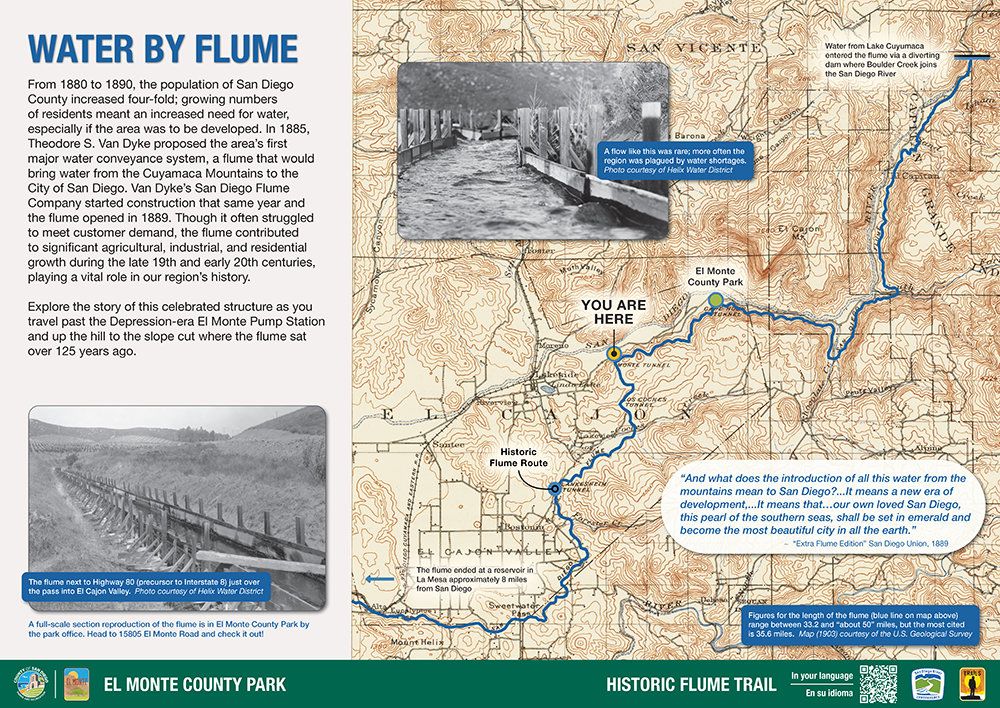
From 1880 to 1890, the population of San Diego County increased four-fold; growing numbers of residents meant an increased need for water, especially if the area was to be developed. In 1885, Theodore S. Van Dyke proposed the area’s first major water conveyance system, a flume that would bring water from the Cuyamaca Mountains to the City of San Diego. Van Dyke’s San Diego Flume Company started construction that same year and the flume opened in 1889. Though it often struggled to meet customer demand, the flume contributed to significant agricultural, industrial, and residential growth during the late 19th and early 20th centuries, playing a vital role in our region’s history.
Explore the story of this celebrated structure as you travel past the Depression-era El Monte Pump Station and up the hill to the slope cut where the flume sat over 125 years ago.
Bottom left photo:
The flume next to Highway 80 (precursor to Interstate 8) just overthe pass into El Cajon Valley. Photo courtesy of Helix Water District
Top inset photo:
A flow like this was rare; more often theregion was plagued by water shortages. Photo courtesy of Helix Water District
Inset quote:
“And what does the introduction of all this water from themountains mean to San Diego?...It means a new era ofdevelopment,...It means that…our own loved San Diego,this pearl of the southern seas, shall be set in emerald andbecome the most beautiful city in all the earth.”
~ “Extra Flume Edition” San Diego Union, 1889
Main map caption:
Figures for the length of the flume (blue line on map above)range between 33.2 and “about 50” miles, but the most citedis 35.6 miles. Map (1903) courtesy of the U.S. Geological Survey
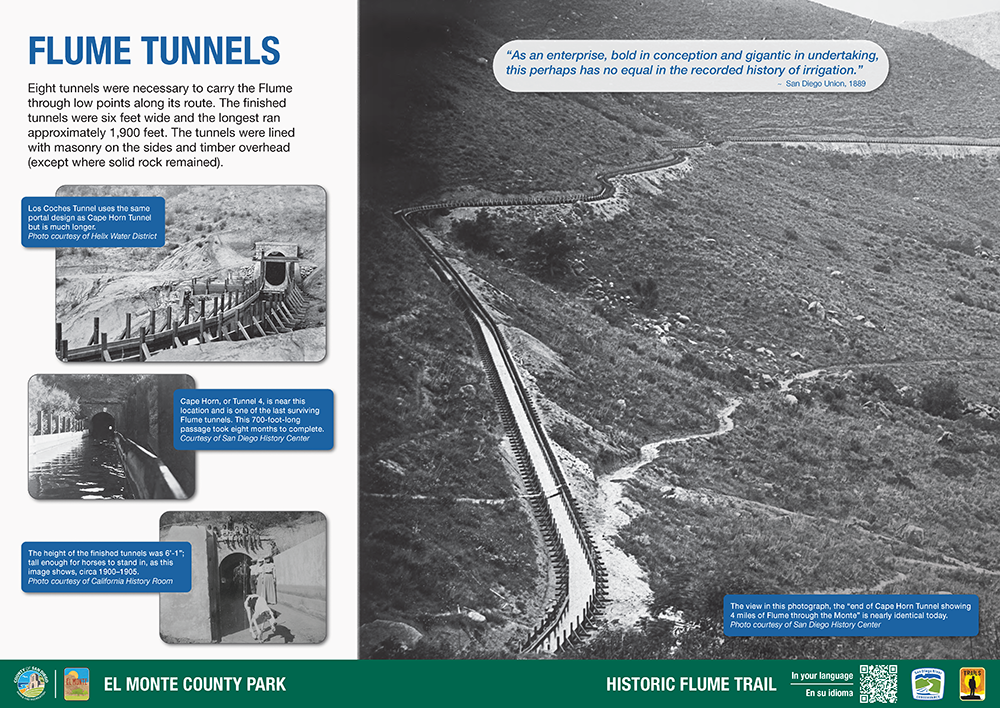
Eight tunnels were necessary to carry the Flumethrough low points along its route. The finishedtunnels were six feet wide and the longest ran approximately 1,900 feet. The tunnels were linedwith masonry on the sides and timber overhead(except where solid rock remained).
Image 1
Los Coches Tunnel uses the same portal design as Cape Horn Tunnel but is much longer. Photo courtesy of Helix Water District
Image 2
Cape Horn, or Tunnel 4, is near this location and is one of the last surviving Flume tunnels. This 700-foot-long passage took eight months to complete. Courtesy of San Diego History Center
Image 3
The height of the finished tunnels was 6’-1”; tall enough for horses to stand in, as this image shows, circa 1900–1905. Photo courtesy of California History Room
Main image
The view in this photograph, the “end of Cape Horn Tunnel showing 4 miles of Flume through the Monte” is nearly identical today. Photo courtesy of San Diego History Center
Quote
“As an enterprise, bold in conception and gigantic in undertaking, this perhaps has no equal in the recorded history of irrigation.”
~ San Diego Union, 1889
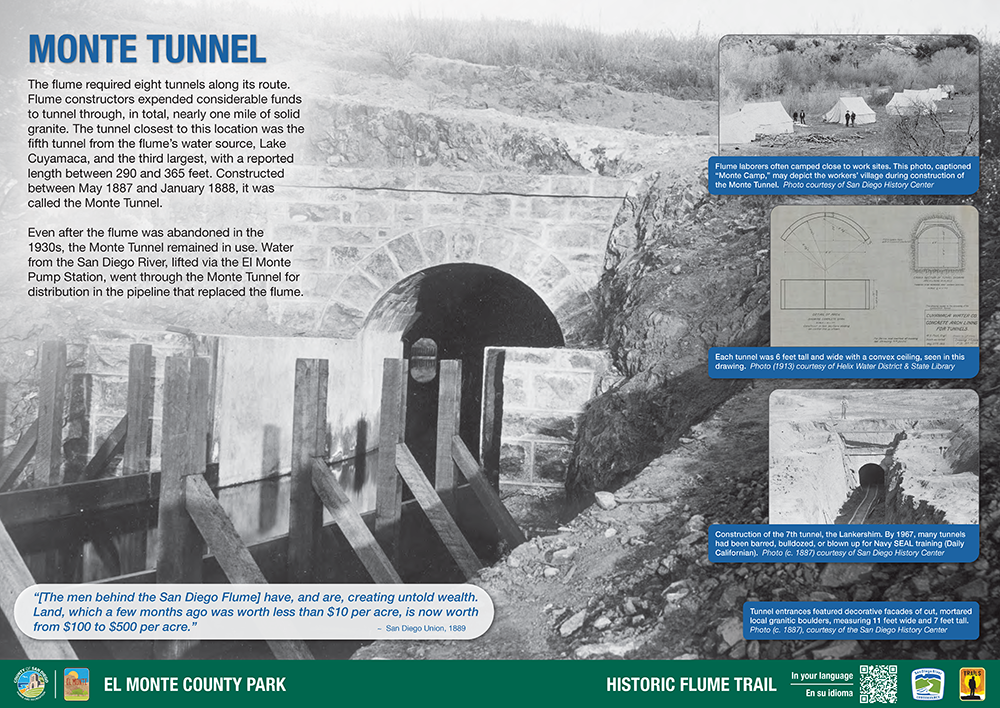
The flume required eight tunnels along its route. Flume constructors expended considerable funds to tunnel through, in total, nearly one mile of solid granite. The tunnel closest to this location was the fifth tunnel from the flume’s water source, Lake Cuyamaca, and the third largest, with a reported length between 290 and 365 feet. Constructed between May 1887 and January 1888, it was called the Monte Tunnel.
Even after the flume was abandoned in the 1930s, the Monte Tunnel remained in use. Water from the San Diego River, lifted via the El Monte Pump Station, went through the Monte Tunnel for distribution in the pipeline that replaced the flume.
Quote
“[The men behind the San Diego Flume] have, and are, creating untold wealth. Land, which a few months ago was worth less than $10 per acre, is now worth from $100 to $500 per acre.”
~ San Diego Union, 1889
Main Photo
Tunnel entrances featured decorative facades of cut, mortared local granitic boulders, measuring 11 feet wide and 7 feet tall. Photo (c. 1887), courtesy of the San Diego History Center
Inset image 1
Flume laborers often camped close to work sites. This photo, captioned “Monte Camp,” may depict the workers’ village during construction of the Monte Tunnel. Photo courtesy of San Diego History Center
Inset image 2
Each tunnel was 6 feet tall and wide with a convex ceiling, seen in this drawing. Photo (1913) courtesy of Helix Water District & State Library
Inset image 3
Construction of the 7th tunnel, the Lankershim. By 1967, many tunnels had been barred, bulldozed, or blown up for Navy SEAL training (Daily Californian). Photo (c. 1887) courtesy of San Diego History Center
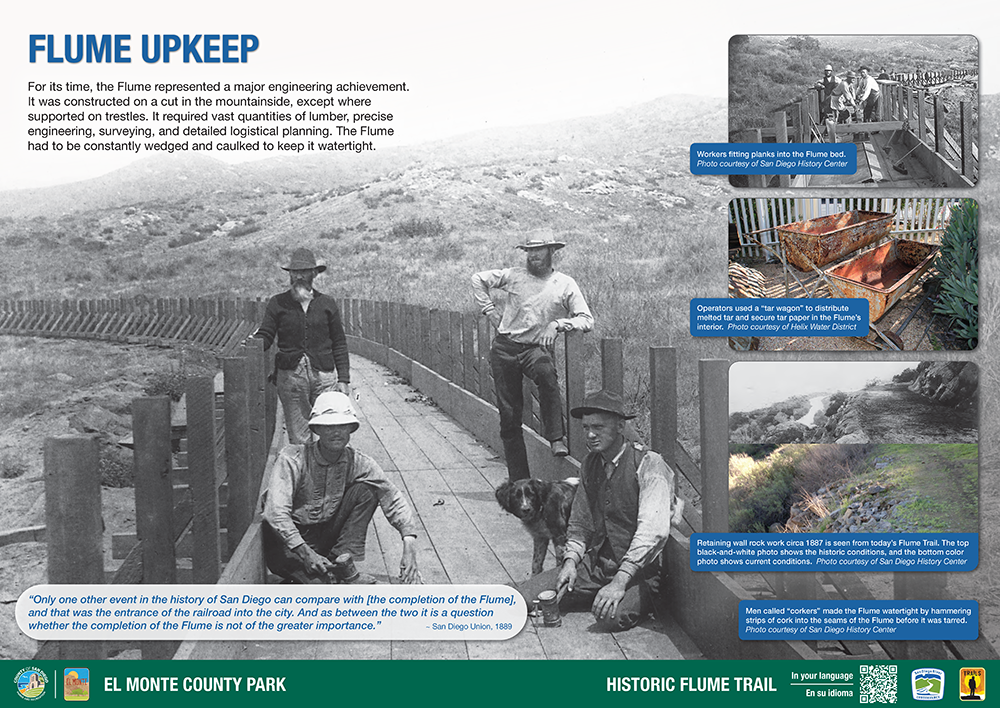
For its time, the Flume represented a major engineering achievement. It was constructed on a cut in the mountainside, except where supported on trestles. It required vast quantities of lumber, precise engineering, surveying, and detailed logistical planning. The Flume had to be constantly wedged and caulked to keep it watertight.
Main image
Men called “corkers” made the Flume watertight by hammering strips of cork into the seams of the Flume before it was tarred. Photo courtesy of San Diego History Center
Image 1
Workers fitting planks into the Flume bed. Photo courtesy of San Diego History Center
Image 2
Operators used a “tar wagon” to distribute melted tar and secure tar paper in the Flume’s interior. Photo courtesy of Helix Water District
Image 3
Retaining wall rock work circa 1887 is seen from today’s Flume Trail. The top black-and-white photo shows the historic conditions, and the bottom color photo shows current conditions. Photo courtesy of San Diego History Center
Quote
“Only one other event in the history of San Diego can compare with [the completion of the Flume], and that was the entrance of the railroad into the city. And as between the two it is a question whether the completion of the Flume is not of the greater importance.”
~ San Diego Union, 1889
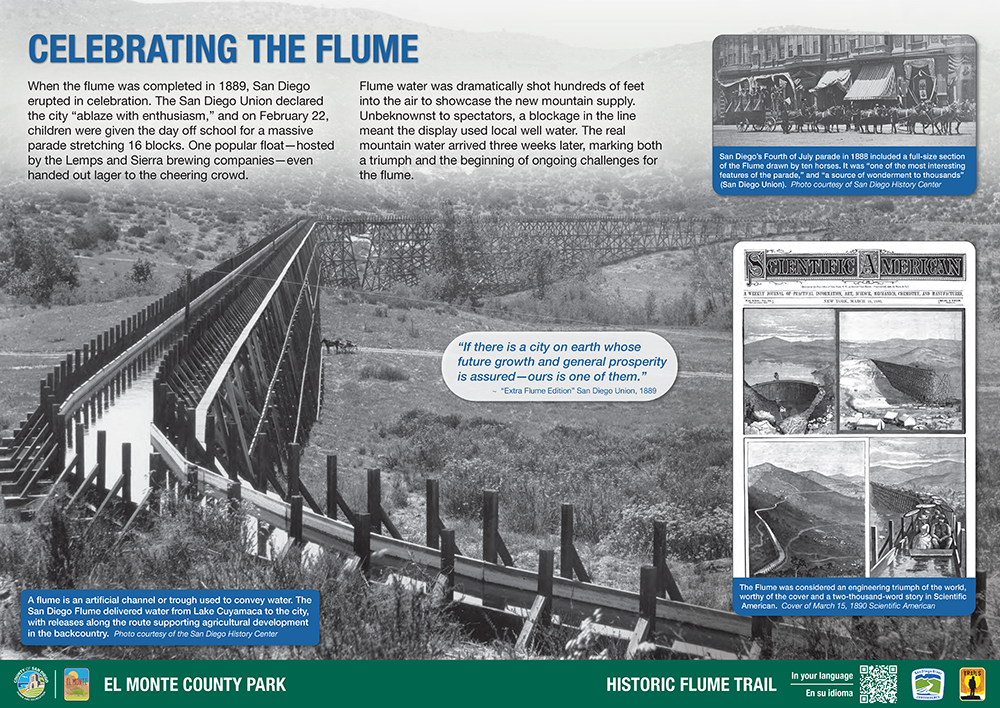
When the flume was completed in 1889, San Diego erupted in celebration. The San Diego Union declared the city “ablaze with enthusiasm,” and on February 22, children were given the day off school for a massive parade stretching 16 blocks. One popular float—hosted by the Lemps and Sierra brewing companies—even handed out lager to the cheering crowd.
Flume water was dramatically shot hundreds of feet into the air to showcase the new mountain supply. Unbeknownst to spectators, a blockage in the line meant the display used local well water. The real mountain water arrived three weeks later, marking both a triumph and the beginning of ongoing challenges for the flume.
Main image
A flume is an artificial channel or trough used to convey water. The San Diego Flume delivered water from Lake Cuyamaca to the city, with releases along the route supporting agricultural development in the backcountry. Photo courtesy of the San Diego History Center
Image 1
San Diego’s Fourth of July parade in 1888 included a full-size section of the Flume drawn by ten horses. It was “one of the most interesting features of the parade,” and “a source of wonderment to thousands” (San Diego Union). Photo courtesy of San Diego History Center
Image 2
The Flume was considered an engineering triumph of the world, worthy of the cover and a two-thousand-word story in Scientific American. Cover of March 15, 1890 Scientific American
Quote
“If there is a city on earth whose future growth and general prosperity is assured—ours is one of them.”
~ “Extra Flume Edition” San Diego Union, 1889
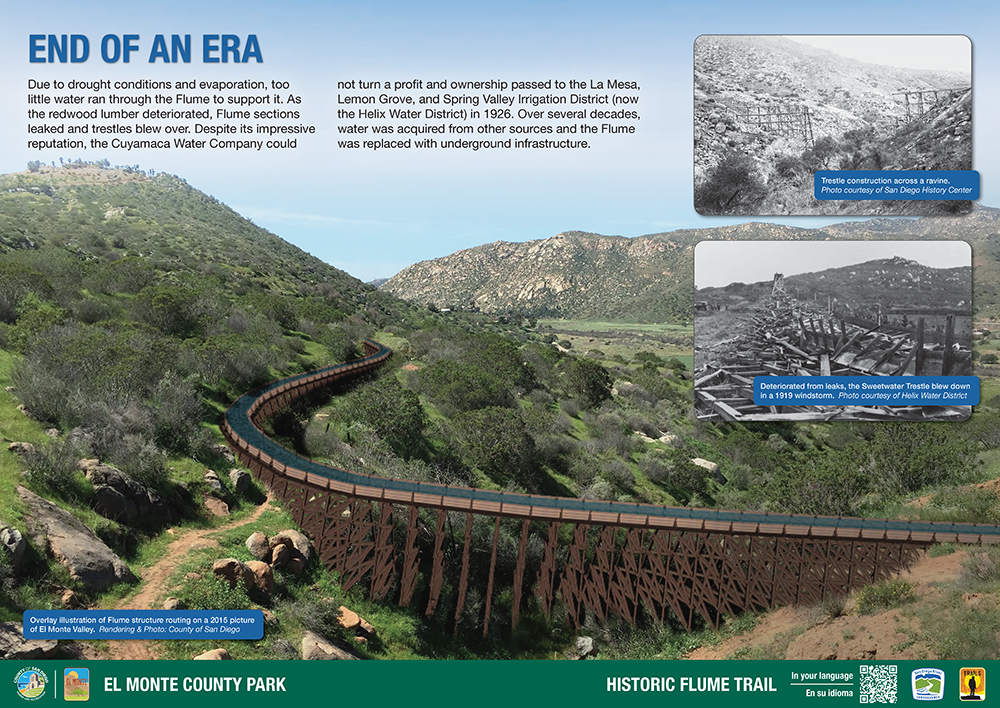
Due to drought conditions and evaporation, too little water ran through the Flume to support it. As the redwood lumber deteriorated, Flume sections leaked and trestles blew over. Despite its impressive reputation, the Cuyamaca Water Company could not turn a profit and ownership passed to the La Mesa, Lemon Grove, and Spring Valley Irrigation District (now the Helix Water District) in 1926. Over several decades, water was acquired from other sources and the Flume was replaced with underground infrastructure.
Main photo
Overlay illustration of Flume structure routing on a 2015 picture of El Monte Valley. Rendering & Photo: County of San Diego
Image 1
Trestle construction across a ravine. Photo courtesy of San Diego History Center
Image 2
Deteriorated from leaks, the Sweetwater Trestle blew down in a 1919 windstorm. Photo courtesy of Helix Water District
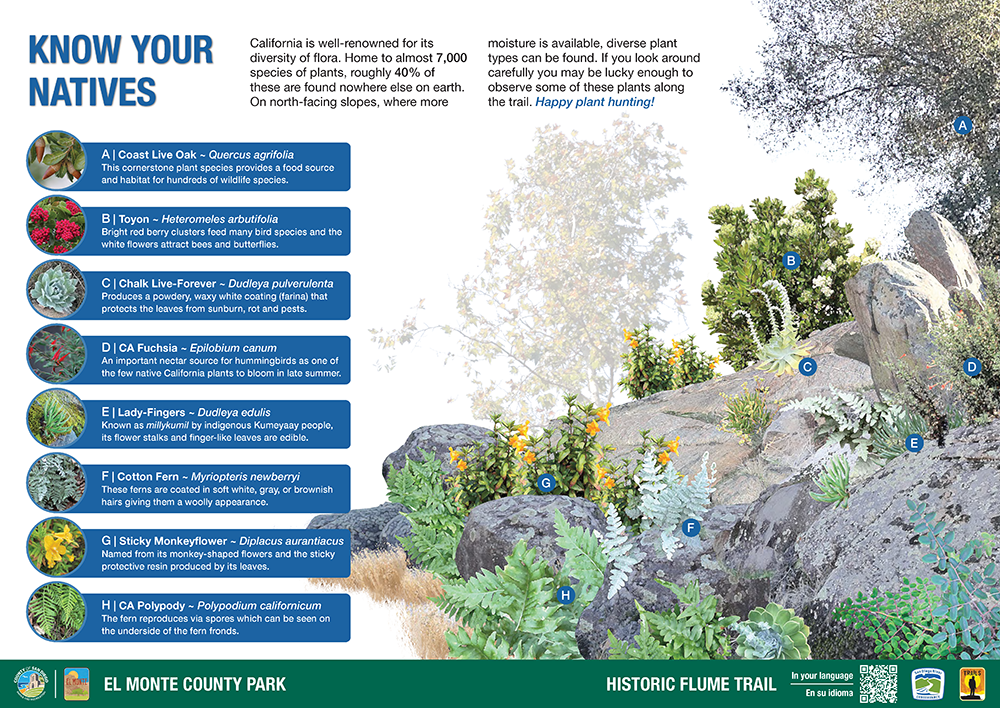
California is well-renowned for its diversity of flora. Home to almost 7,000 species of plants, roughly 40% of these are found nowhere else on earth. On north-facing slopes, where more moisture is available, diverse plant types can be found. If you look around carefully you may be lucky enough to observe some of these plants along the trail.
A | Coast Live Oak ~ Quercus agrifolia
This cornerstone plant species provides a food source and habitat for hundreds of wildlife species.
B | Toyon ~ Heteromeles arbutifolia
Bright red berry clusters feed many bird species and the white flowers attract bees and butterflies.
C | Chalk Live-Forever ~ Dudleya pulverulenta
Produces a powdery, waxy white coating (farina) that protects the leaves from sunburn, rot and pests.
D | CA Fuchsia ~ Epilobium canum
An important nectar source for hummingbirds as one of the few native California plants to bloom in late summer.
E | Lady-Fingers ~ Dudleya edulis
Known as millykumil by indigenous Kumeyaay people, its flower stalks and finger-like leaves are edible.
F | Cotton Fern ~ Myriopteris newberryi
These ferns are coated in soft white, gray, or brownish hairs giving them a woolly appearance.
G | Sticky Monkeyflower ~ Diplacus aurantiacus
Named from its monkey-shaped flowers and the sticky protective resin produced by its leaves.
H | CA Polypody ~ Polypodium californicum
The fern reproduces via spores which can be seen on the underside of the fern fronds.
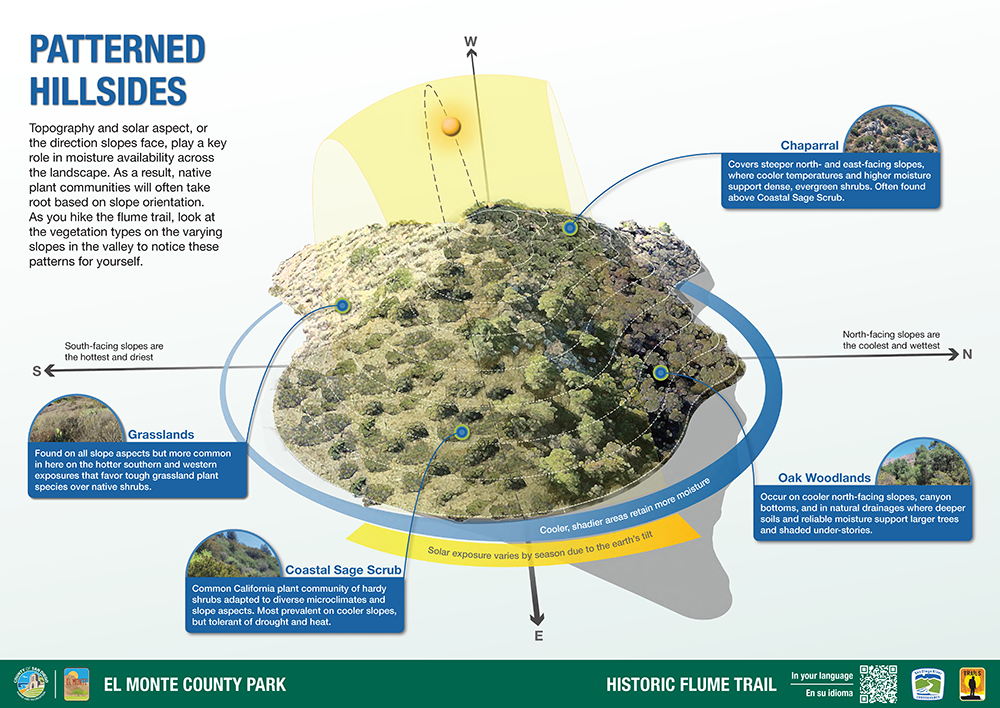
Topography and solar aspect, or the direction slopes face, play a key role in moisture availability across the landscape. As a result, native plant communities will often take root based on slope orientation.As you hike the flume trail, look at the vegetation types on the varying slopes in the valley to notice these patterns for yourself.
Left-center image
Grasslands - Found on all slope aspects but more common in here on the hotter southern and western exposures that favor tough grassland plant species over native shrubs.
Left-bottom image
Coastal Sage Scrub - Common California plant community of hardy shrubs adapted to diverse microclimates and slope aspects. Most prevalent on cooler slopes, but tolerant of drought and heat.
Right-top image
Chaparral - Covers steeper north- and east-facing slopes, where cooler temperatures and higher moisture support dense, evergreen shrubs. Often found above Coastal Sage Scrub.
Right-bottom image
Oak Woodlands - Occur on cooler north-facing slopes, canyon bottoms, and in natural drainages where deeper soils and reliable moisture support larger trees and shaded under-stories.
Middle Image
Blue Circle - Cooler, shadier areas retain more moisture
Yellow circle - Solar exposure varies by season due to the earth’s tilt